Paying Cash May Beat Your Copay: A Plain-Language Guide to Affordable Antimicrobials in the U.S.
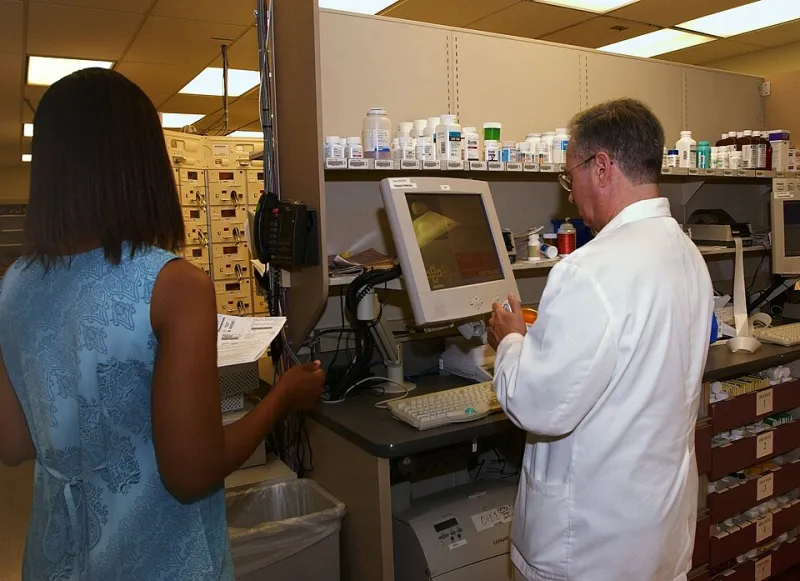
Photo: U.S. Navy photo by Chief Warrant Officer 4 Seth Rossman., Public domain, via Wikimedia Commons
A course of amoxicillin should never be a financial event. Yet for the tens of millions of Americans who are uninsured, underinsured, or stuck in high-deductible plans, the price at the pharmacy counter is often the deciding factor in whether an infection gets treated at all. The good news: the U.S. pharmaceutical market has quietly built an entire infrastructure of discounts, and most people never learn to use it.
Start With the Generic Lists
Large national chains have long maintained lists of common generics priced at a flat $4 for a standard supply, with 90-day fills often available for around $10. Dozens of widely prescribed antimicrobials appear on these lists, including:
- Amoxicillin and amoxicillin-clavulanate
- Penicillin VK
- Doxycycline
- Cephalexin
- Azithromycin (the standard five-day pack)
- Trimethoprim-sulfamethoxazole
- Ciprofloxacin
These lists are public, searchable, and require no membership beyond the pharmacy itself. If your prescription appears on one, cash price is frequently your best deal—no insurance involved.
Discount Cards: Free Money With Fine Print
Negotiated discount programs—some run by pharmacy chains, others by third-party negotiators—can cut prices on drugs not covered by generic lists. They work by pooling negotiating leverage and passing some of it to the consumer. Two caveats:
- You cannot combine a discount card with insurance. It is one or the other.
- Prices for the identical drug and dose vary by pharmacy and by ZIP code, sometimes by hundreds of percent. Always price-check at more than one location before committing.
Manufacturer Savings Cards
For brand-name antimicrobials—certain branded formulations and newer agents—manufacturer copay cards can reduce out-of-pocket costs substantially for commercially insured patients. Note that federal law prohibits these cards for Medicare and Medicaid beneficiaries, so eligibility depends on your coverage type. Manufacturer patient websites host the current offers.
340B Clinics and Community Health Centers
Federally qualified health centers participate in the 340B drug pricing program, which lets them purchase outpatient medications at steep discounts and pass savings along, particularly to uninsured and underinsured patients. If you lack coverage, a community health center can be a one-stop solution: sliding-scale visit fees paired with reduced drug pricing, often in the same building.
Patient Assistance Programs
Pharmaceutical manufacturers operate assistance programs for patients who meet income criteria and cannot afford prescribed medications. Enrollment typically requires an application completed with your prescriber's office. For expensive antimicrobials used in chronic infections—think long courses for osteomyelitis or resistant tuberculosis regimens—these programs can be decisive.
The Step-by-Step Price Comparison
Before you fill any prescription, run this five-minute check:
- Ask the pharmacist for the cash price. By law, they can tell you; you do not have to reveal your insurance status.
- Ask whether the drug appears on the store's generic discount list.
- Compare at least one discount card price for your exact drug, dose, and quantity at that pharmacy—and at a competing pharmacy.
- Compare against your insurance copay or coinsurance. For high-deductible plans, you may be paying the full negotiated price anyway until your deductible is met, in which case the discount card often wins.
- Ask about therapeutic alternatives. If two antibiotics are clinically equivalent for your infection, one may cost a tenth of the other.
A common outcome: a $45 insurance copay for a medication available for $6 cash on a generic list. Pharmacists report this daily. Nobody at the counter will volunteer the comparison unless you ask.
A Closing Word on Access
Affordability is a stewardship issue. When a course of treatment is skipped, split, or abandoned because of cost, under-dosing breeds resistance just as surely as overuse does. Knowing how to navigate discount structures protects both your health and the effectiveness of the antimicrobial arsenal we all share. Bring the list above to your next pharmacy visit—and don't be shy about asking the question that saves you forty dollars.